

By: Gabrielle Camilli
Land surveying is one of the most critical yet often overlooked professions in bringing projects in the built environment to life. But the industry is facing a major challenge: a shrinking pipeline of talent. Cuts to apprenticeship programs and college/university survey curricula, coupled with an aging workforce (the average licensed land surveyor in the U.S. is now 58), have left the profession at a crossroads.
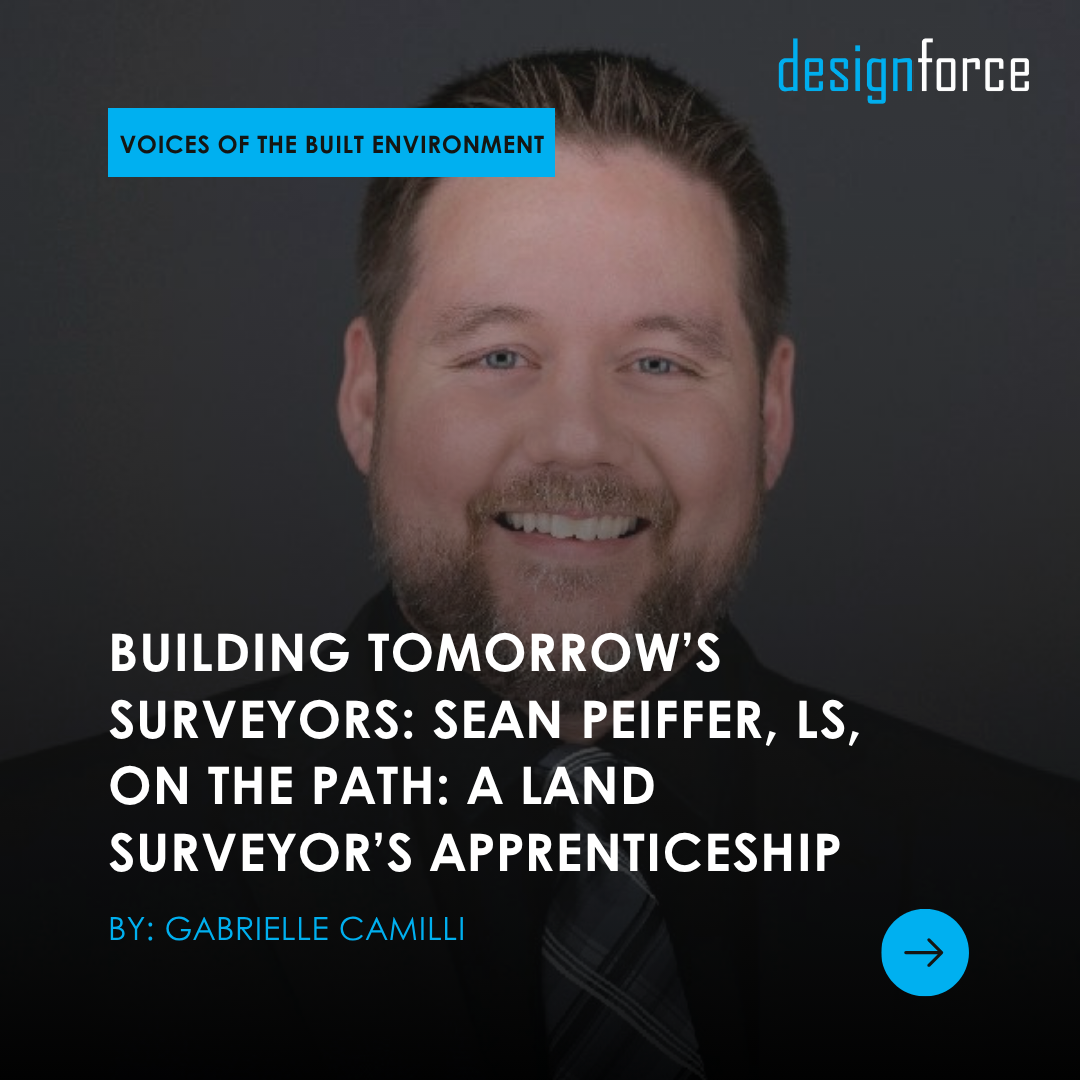
One man is determined to change that. Sean Peiffer, LS, Fairfax Operations Manager at Charles P. Johnson & Associates, and a former instructor and graduate of the now-shuttered Fairfax County ACE Surveying Apprenticeship Program, was motivated by its closure to collaborate with fellow survey professionals, the Virginia DPOR, and Virginia Works Registered Apprenticeship to create a new survey apprenticeship program, The Path. In this conversation, we explore his career in land surveying, the changes shaping the profession, and how he’s helping secure its future.
What drew you into the profession of land surveying?
My dad has been a surveyor with Dewberry for 45 years, and my uncle was a surveyor for his entire career out in the Southwest; I grew up with early exposure to the profession. On teacher workdays, I’d sometimes tag along with my dad to his job. For a few years, he worked out of a construction trailer at Dulles Town Center. I vividly remember visiting one year when his trailer sat in the middle of the woods. When I came back the next year, the same trailer was suddenly in the middle of a parking lot. I asked if they had moved it, and he said, ‘No, it’s the same spot.’ That moment really opened my eyes to how rapidly and drastically land development can transform an environment.
Family ties may have pulled me in, but it was the diversity of the work that made me stay. I’ve spent months riding through the mountains on four wheelers, working along the coast, trekking through swamps, and navigating class one clean rooms at microchip plants. Every experience was different and never boring. That variety is what hooked me and kept me here.
What inspired you to become such a strong advocate for mentorship in this industry?
There were several factors that influenced my passion for mentorship. I was fortunate to have some amazing mentors early in my career. I still consider one of my apprenticeship instructors, Vickie Anglin, a valued mentor even today. These mentors supported me through my own apprenticeship path, but even back then it was clear that both apprenticeship and mentorship in surveying were struggling. At first, I just wanted to contribute and give back, following the path of those mentors who helped me.
Around 2019 or 2020, Yeoanny Venetsanos, who had been teaching, wanted to step back to focus on grad school and asked if I’d be interested in taking over for him as an instructor for both the ACE Apprenticeship, as well as the VAS John Foster School. Before that, I’d only taught small technical forums and short sessions, but this was my first chance to teach larger groups for extended periods. That experience sparked a real passion for teaching and opened my eyes to just how serious the gaps in our profession are.
Since then, that spark has only grown. From the classroom to Capitol Hill, I’ve been driven to promote our profession and provide support for those who come after. One of my favorite moments is working with first-year apprentices and seeing the lightbulb turn on when they realize something they’ve been doing now makes complete sense because they finally understand the principle behind it. Those moments fuel my commitment to mentorship and to strengthening the surveying pipeline.
Why are apprenticeship programs critical to the land survey profession?
You’re growing your skilled workforce, plain and simple. One of the biggest arguments for apprenticeships is that many students do go on to get licensed, but even those who don’t still come out of the program as stronger, more capable surveyors.
When the program was run through Fairfax County Public Schools, it only cost about $5,000 to $6,000 from start to finish. That’s a relatively small investment for firms looking to build their workforce. And for many people, that structure just works better for them. They thrive when they can take class one day a week while receiving structured, on-the-job training from a qualified mentor.
Traditional higher education isn’t the right fit for everyone. Some people don’t test well; others find the classroom environment or heavy workload overwhelming. But that doesn’t mean they can’t learn or make meaningful contributions to the profession; they just need an alternative path to develop those skills.
Talk to me about the apprenticeship program you’re launching, The Path
In Virginia, to pursue licensure via apprenticeship, you need 10,000 hours of on-the-job training and 720 classroom hours. Our curriculum, which is now state-approved, provides roughly 600 structured classroom hours and about 120 elective hours, things like CAD classes or other specialized topics.
The five modules are designed to roughly coincide with each year of the five-year on-the-job training period. It’s a learn-at-your-own-pace program, so if a student completes two modules in one year, that’s fine, they still need to fulfill the full 10,000 hours of hands-on field and office experience.
The program will be facilitated through an AI-powered Learning Management System, which we’ve trained to deliver the content. Students will engage with interactive video lessons, part lecture, part hands-on examples. Every 10 minutes or so, there’s some kind of interaction, whether it’s talking to the AI, completing a small exercise, or providing feedback. The goal is to keep students actively engaged while building the foundational knowledge they need to become licensed surveyors.
The Path will also include content designed to help mentors provide their apprentices with appropriate on-the-job training as well as manage their paperwork to ensure students achieve necessary compliance to advance their careers.
How can people get involved and support this program?
Right now, we are still in development. I do have a contact form so folks can get added to the mailing list, and there have been a couple of social media posts. Soon, we will start sending out updates to the mailing list, start doing some meaningful fundraising, and so on. Our hope is to launch around April of next year. Interested parties can also reach out directly to myself, or the other members of the Board of Directors, Beth Anne Campbell, or Joanna Hansen.
What would you say to someone considering a career in land surveying?
It’s a viable career for anyone who wants to spend time outdoors, whether in the mountains or on a project site, and for those fascinated by the mix of history, art, and science. I get to work in augmented reality, modeling point clouds collected by drones, on the same projects where I’m researching documents from the 1800s to trace their origins. It’s absolutely fascinating, and you can make a good living doing it.
Interested in supporting The Path and their mission? Sign up to for their newsletter today!
Related Posts








Let's learn together.
Stay inspired and in the know on all things A|E|C.
Sign up for our monthly newsletter.