

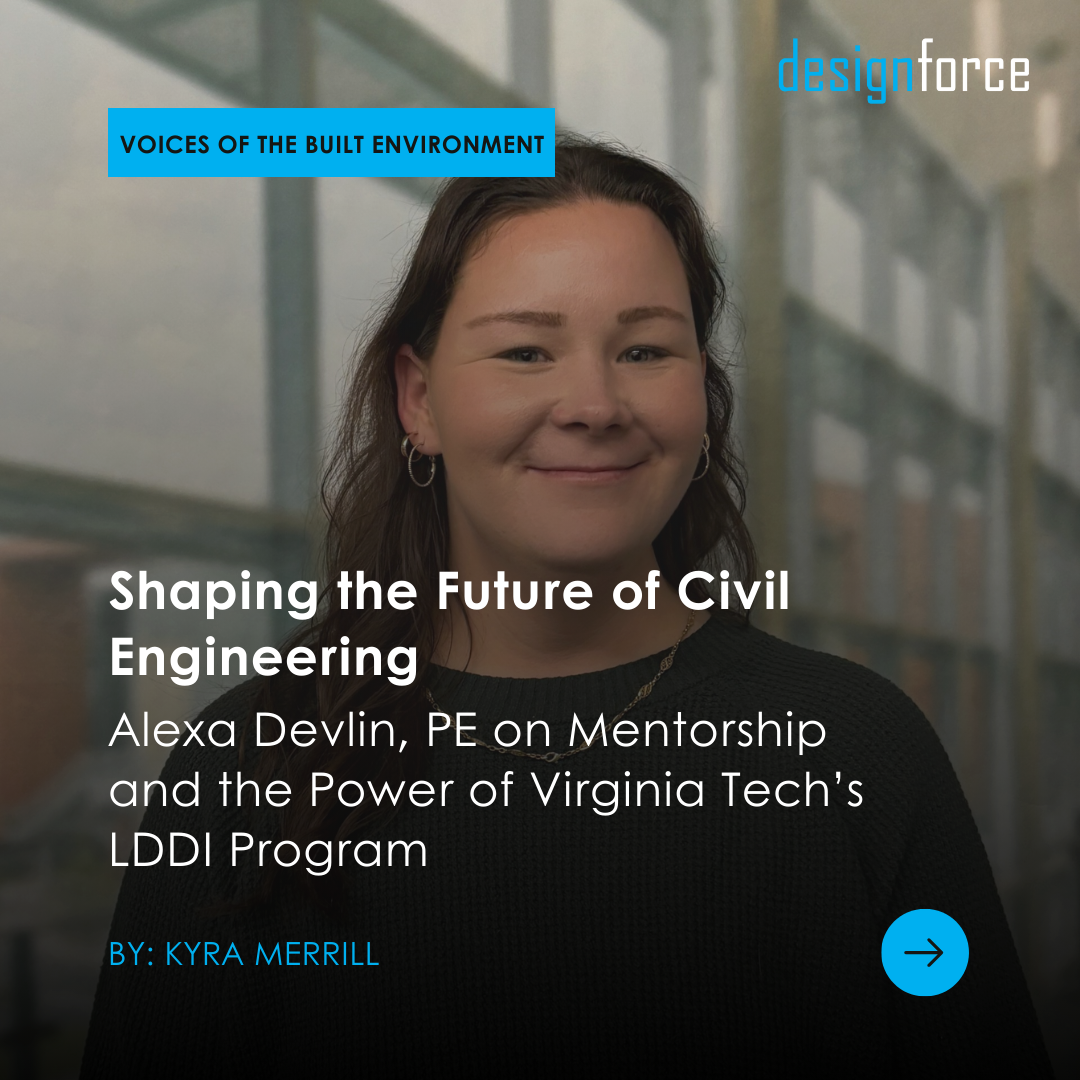
By: Kyra Merrill
If you’ve spent any time in the DMV civil engineering world, you’ve probably met Alexa Devlin, Deputy Project Manager at Dewberry. When she’s not planning events as the Special Events Chair for Virginia Tech’s LDDI (Land Development Design Industry), a program that bridges education, research, and industry to train future civil engineers in sustainable land development, she’s mentoring aspiring engineers, and helping them get ready for the real-world challenges of the workplace. I had the chance to sit down with her and hear about her journey with LDDI and how it shaped her career. The advice and stories she shared were absolutely priceless.
Could you share more about how you first got involved with LDDI at Virginia Tech and what drew you to participate beyond graduation?
I actually went through Virginia Tech without being very involved in LDDI. I took the senior design class mainly for the job placement. After graduation, I went into general contracting for six months, and I didn’t enjoy it as much as I thought I would. That experience pushed me back towards land development and what I learned from senior design which ultimately helped shape my career.
I wasn’t heavily involved with LDDI through my first company but I always wanted to mentor the senior design class. I loved the idea of being on the other side, giving back and helping students answer the same questions we once asked, like how professionals seem to “know so much.” Supporting the next generation has become one of my favorite parts of my career.
To mentor formally through LDDI, you need to be affiliated with a sponsoring firm or work closely with the LDDI coordinators. As a young engineer without those connections, I was encouraged to get involved through a committee and I chose the Special Events Committee. About a year later, I was asked to step into the role of chair, a position I still hold today.
Serving as chair has become my first real long-term leadership experience outside of sports. While our focus is on events, we come together to collaborate, support each other and have fun. In a competitive industry, it is special to have a space where people come together with mutual respect. I’ve stayed involved with LDDI ever since and while I may not be chair forever, I fully expect to remain involved for the long term.
What did you learn about leadership? Was there a learning curve? Were there challenges in the beginning? And how have you developed since then?
I still reflect on myself a lot. The meetings with the LDDI Special Events committee are often the most challenging, not because of the workload, but because they center on opinions and feelings. Our goal isn’t necessarily to produce the “best” product, but to create a positive experience, which requires a very different communication style.
I’ve realized it’s a challenge to encourage participation while ensuring everyone feels heard and valued. You want people to share their opinions freely but not be discouraged if their ideas aren’t used. We try to acknowledge suggestions thoughtfully. For example, we might say, “I loved your idea; it might not fit this venue, but we’ll use it in the future.” Encouraging people to take the lead while keeping them engaged has been an interesting challenge.
Volunteer leadership also has its own unique challenges. Unlike the workplace, where tasks are clearly defined, everyone here is giving their time outside of busy professional schedules. Finding time, especially during busy seasons like golf tournament sponsorships or venue planning, can be tricky. Decisions like picking a venue often set the pace for everything else, so timing can be stressful.
Do you feel that having the experience of coming together and fostering unity within the industry, has influenced the way you approach your work?
I think it definitely helps. I’m lucky to work at Dewberry, where the culture gives me a lot of practice communicating across different disciplines and levels. We do a lot of cross-team collaboration, so it’s not just talking to people in the same experience range. It’s also people from all areas, which gives me valuable practice.
At the same time, LDDI helps bridge gaps that some companies might not be able to provide. In some offices, you don’t get that kind of versatility in who you interact with. Even meetings that feel a little tense can be growth moments, teaching you how to navigate challenging discussions. The more you experience that, in any setting or committee, the better prepared you are for whatever situations come your way.
What advice would you give to young professionals who are thinking about getting involved with organizations outside of work?
If you want to get involved, my advice is to say yes to opportunities but make sure you prioritize your main responsibilities at work. Show your managers that you can handle your regular duties while also taking on extra responsibilities, whether it is joining a committee or leading one. It’s a great way to build soft skills, network, and communicate with other professionals.
Attending events and engaging with students reflects positively on your company. Anyone can be looked up on Google, but making personal connections matters. Building that network is important not just for career opportunities, but also for feedback and perspective. It helps you understand if what you are doing is on par with industry standards and identify areas to improve. Surrounding yourself with people who challenge and push you is a great way to grow professionally and personally.
What general advice would you give to young professionals just starting out in Civil Engineering, especially here in the DMV?
Just keep trying. One of the hardest things, especially when starting out, is learning how to give and receive feedback. It can be tough to spend hours on something and then have someone review it in ten minutes and point out multiple flaws. You have to remember that everyone is trying to help create a product that’s safe, accurate, and efficient for the client.
One of the biggest lessons is to understand why feedback is given. It’s not just a list of corrections meant to overwhelm you. Someone took the time to make those markups, and understanding their reasoning helps you grow. Early in my career, I was guilty of just trying to “get it done” without fully understanding it. Now, I make sure to follow through, ask questions, and really understand the feedback. Communication is key, and it’s a two-way process. You need to be inquisitive and open to learning from those with more experience.
Final Thoughts
Alexa Devlin’s journey through LDDI and her early career in civil engineering highlights the importance of mentorship, collaboration, and continuous learning. From navigating feedback and embracing imperfection to building connections across the industry, her experiences show that growth comes not just from technical skills but from communication, curiosity, and teamwork. For young professionals entering the field, her advice is clear: say yes to opportunities, seek out feedback, and invest in relationships. By doing so, you not only strengthen your own career but also contribute to a stronger, more connected civil engineering community.
Related Posts



Let's learn together.
Stay inspired and in the know on all things A|E|C.
Sign up for our monthly newsletter.