

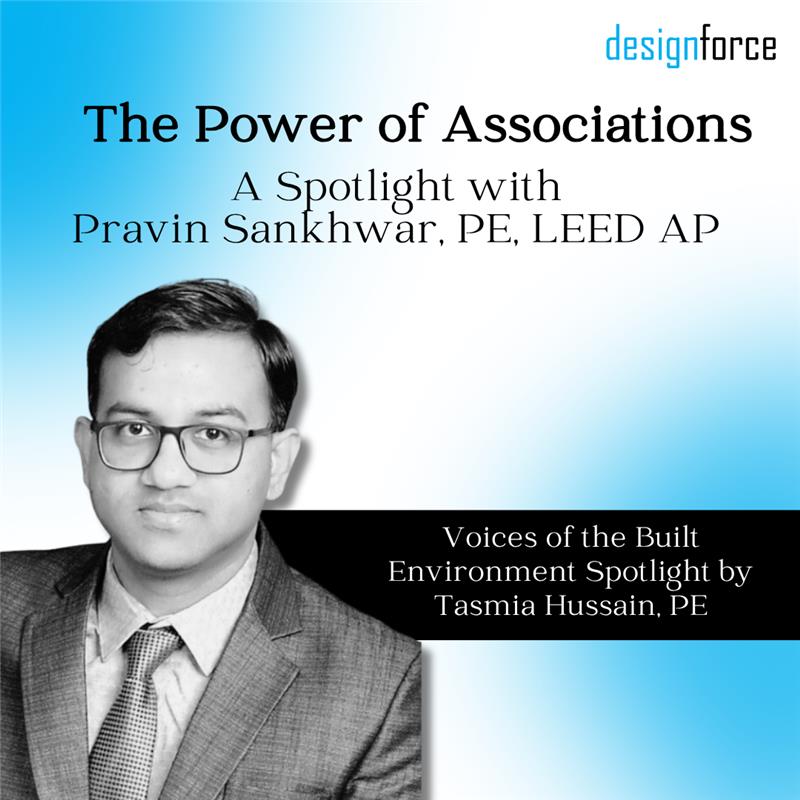
By: Tasmia Hussain, PE
If you could go back in time and give your younger self career advice, what would it be? For me, I wish I could go back and convince myself to expand my professional circle outside of just my firm! As a former Mechanical Engineer in the AEC industry, I know how hard it is to see the big picture when you are so focused on day-to-day work. But having gotten much more involved in associations within the past few years, I have seen firsthand the power of building great relationships and elevating my industry IQ through this involvement.
Pravin Sankhwar, PE, LEED AP, a senior electrical engineering professional, is no stranger to volunteering in our industry. I had the privilege of speaking with Pravin about the gains he has made in his professional career through his involvement in association work, check out our interview below:
What societies are you involved with currently?
I am very active in the Institute of Electrical and Electronics Engineers (IEEE) committees. My recent participation has been as a conference co-chair for the Baltimore Technical Colloquium. I am also a Principal member of the National Electrical Safety Code (NESC) subcommittee where my role is to vote for amendments to standards. Lastly, I am an editorial board member for STM Journal, an academic and professional publisher. I am responsible for reviewing and providing feedback on technical papers.
What made you get involved in different industry associations?
There are a few things that motivated me to join associations. I wanted to be able to learn about what is going on in the industry. These meetings are a great way to stay up to date on the new technology and standards going on in our field. I also wanted to learn how to network. Associations are a great opportunity to meet a diverse group of people – not just in terms of type of people, but also their professional backgrounds. I am from the building industry, but there are people I meet at these association events from totally different worlds! There may be electrical engineers working in manufacturing or on devices or in the field of artificial intelligence (AI). There is always something relatable about the people you meet and ultimately, it’s good to know how their fields may impact the construction and building industry.
Do you find it difficult to balance your involvement in industry associations with work, life, and other responsibilities?
The key to success when balancing these different responsibilities is maintaining a schedule. This applies to work of course – keeping up with deadlines, meeting the expectations of clients, and collaborating with team members. But I focus on scheduling not just in my current role with my firm but also when I am participating in volunteer roles.
I personally keep track of my activities in Google Calendar and use it to understand when volunteer meetings are occurring and how to best balance it with my work responsibilities. Luckily, I am able to keep up!
One thing to note when getting involved in these professional societies is, especially in board or committee positions, they require time outside of your 9-5 job. Often, you may be putting in some time before or after work or on the weekends. That is something one must have an open mind to when engaging in these kinds of activities.
But it is so worth it. It adds a lot of professional value to my profile and has helped me build a strong reputation in the industry. It helps me build good relationships with clients and shows them that I am a professional engineer who is actively engaging in activities that help me improve designs. You do this through quality design work of course, but also through quality knowledge. You may not always be able to gain that quality knowledge purely through your role at work. You often gain some of that professional development and knowledge from external societies. That professional growth is what I try to focus on and is what motivates me to stay involved.
What are some other skills you have gained from being involved in technical societies?
I’ve picked up a lot of interpersonal skills. For example, being involved as a co-chair for a conference requires a lot of leadership and managerial capabilities. I’ve learned how to manage people who have differing opinions and be able to have a large group come to a consensus on decisions.
I’ve also learned so many analytical and technical skills. For example, when I joined NESC as a principal member, it helped me not only learn what is in the standards, but also get more insight into the process of how and why these standards are developed. Seeing the ‘behind the scenes’ helped give me more context for why we apply these standards in design. This is a perspective that not all engineers get through their regular jobs.
What would you say to someone who may be hesitant or nervous to join a professional society?
I would say it’s okay to be nervous initially. It can be nerve wracking to meet and interact with a large group of people. My advice would be to do some brainstorming before the meeting. Most of the time, people feel nervous because they may not know much about the topic. For example, if I attend a meeting with an IEEE society, I would ask myself, ‘what exactly are we going to discuss there?’ Do some research on who the speakers are. Look at the background of some of the participants. This can help you understand what to expect and maybe think of some questions you can ask.
Eventually, after you show up to a few meetings, you will get used to the feeling. Trust me, everyone there is cooperative and knows that participants are volunteering their time to be there. People encourage growth and involvement at these events and people who have an open-minded and curious mindset succeed, even if they are nervous.
Are there any final thoughts you would share with a professional who is considering joining an industry association?
Joining an association can generally be a great place to understand more about career paths and how to grow in your career, especially for a young professional. For example, in your current workplace, you may not see people encouraging you to get professional licenses or some lesser-known certifications. You can often be bound to the experiences of your immediate team or what your supervisor and peers are aware of. But when you start engaging in these societies, there is more opportunity to explore paths that may not be as visible and can allow you to grow in different ways.
Also, as a young professional, it’s hard to sometimes understand the power of networking, but these societies can be very helpful in building relationships and getting support in your career. I would say, don’t keep your doors closed – open them up.
Final Thoughts
I hope Pravin’s insights can encourage you to join an industry association! Whether you are just starting out in your career or are a seasoned professional, it is always a great time to consider expanding your network, technical knowledge, and overall involvement in the industry. If you ever want to talk more about networking opportunities or ways to grow your career, please reach out to me at th@designforce.me!
Related Posts






Let's learn together.
Stay inspired and in the know on all things A|E|C.
Sign up for our monthly newsletter.