

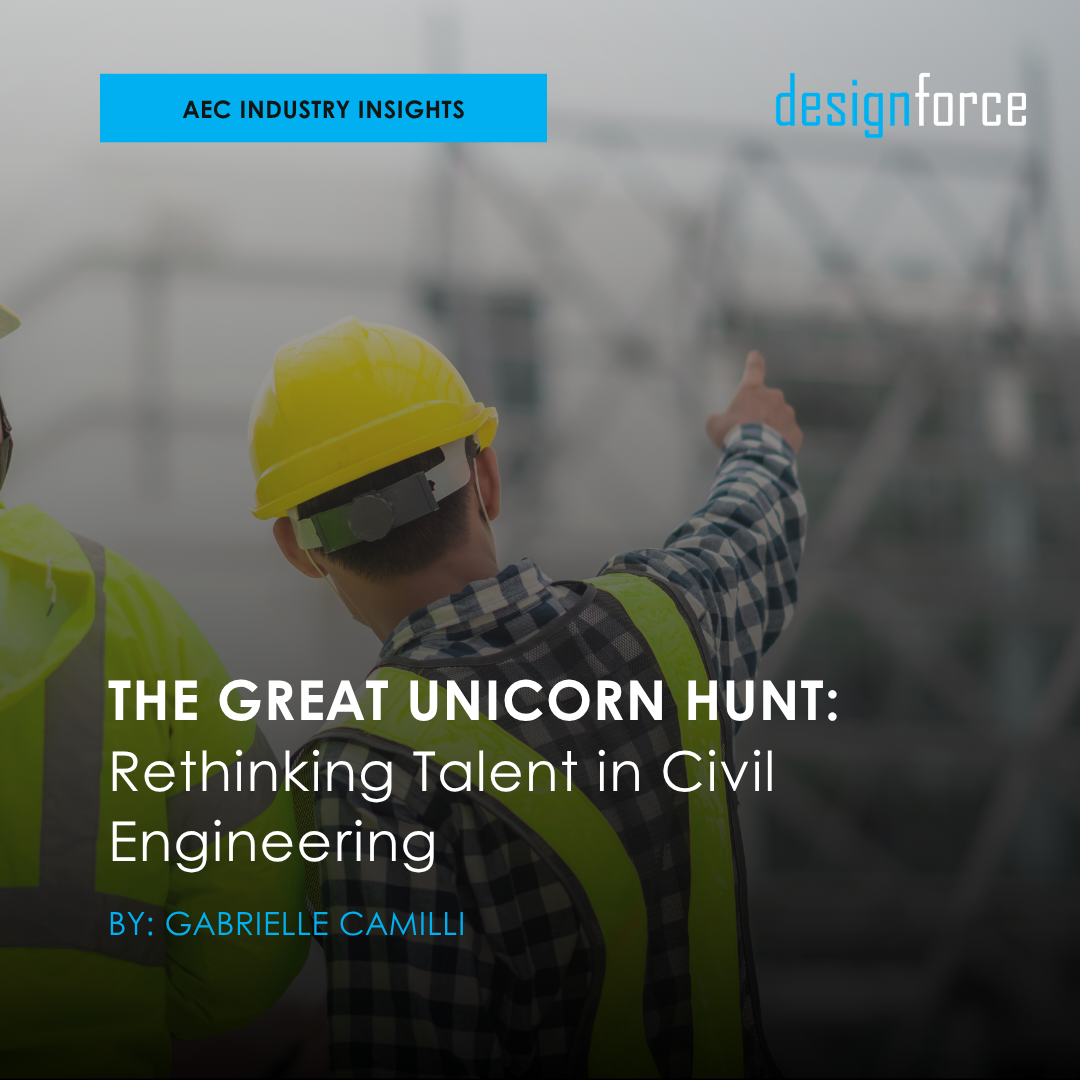
By: Gabrielle Camilli
“We need a licensed civil engineer with 12-15 years of experience, strong client skills, leadership ability, technical depth, and someone who is growing a book of business.” As someone who spends their days talking to civil engineering firms across the country, I hear some version of this request almost every week.
To be clear, I understand why they are asking for this. These professionals are incredibly valuable; they drive project performance, strengthen client relationships, mentor younger staff, and often drive overall growth for the firm. The problem is that nearly every firm is looking for the exact same person. Yet many firms continue to approach hiring as though that talent is readily available if they just search hard enough or hold out long enough.
The civil engineering talent shortage isn’t a temporary challenge. It isn’t the result of a hot market that will eventually cool down. It is the outcome of several long-term trends that have been building for more than a decade.
The Great Recession Created a Gap We Never Recovered From
When the economy collapsed in 2008, the AEC industry wasn’t just hit hard; it came to a complete and utter halt.
For several years, many aspiring civil engineers struggled to find opportunities in the industry. Some delayed graduation, some changed majors, and many found entirely different career paths. Those individuals would now have approximately 13 to 17 years of experience. They would be today’s project managers, senior engineers, group leaders, and future firm owners.
Fast forward to today, many firms find themselves operating under the empty sandwich model, with a healthy population of entry-level staff and a significant number of senior leaders approaching retirement, but not much in between.
The Numbers Simply Don’t Work
The challenge doesn’t stop there. Every year, the United States produces far fewer civil engineering graduates than the industry needs. According to the US Bureau of Labor Statistics, the U.S. is projected to have roughly 23,600 civil engineering openings each year over the next decade, while universities produce only about 16,000-18,000 civil engineering graduates annually; that’s a delta of at least 5,000 engineers.
At the same time, infrastructure investment continues, communities continue to grow, and experienced professionals continue to retire. Even when firms successfully recruit graduates, not every graduate enters consulting. On top of this, immigration changes at the federal level are making it less viable to rely on international talent to solve this gap.
The result is a pipeline that struggles to replace the talent that is leaving, let alone support future growth.
The Competition Has Changed
One of the biggest misconceptions I see among design consultancies is the belief that they are primarily competing against other consulting firms for talent.
They’re not. They’re competing against local government that can promise work-life balance, developers and owners offering more compensation, contractors, utility providers, the list goes on.
The reality is, many mid-level engineers spend the first years of their career motivated by the big, glorious, north star of passing their PE. They then pass it, look around and ask themselves, “What’s next?” They start to look closely at their senior leaders and ask themselves, “Do I really want that job?”
The Search for Purple Unicorns
Despite these realities, many firms continue to search for the perfect candidate. The licensed engineer who’s also a technical expert, rainmaker, people leader, mentor, culture champion, and is also versed in your exact jurisdictions and project typologies.
The person who can hit the ground running on day one with virtually no development required. Don’t get me wrong, those people exist. There just aren’t enough of them.
And when they do become available, every firm in the market wants to hire them.
How Can Design Consultancies Adapt?
If the talent market has fundamentally changed, then hiring strategies must change as well.
First, firms need to broaden their definition of a qualified hire. Potential may matter more than perfection. The candidate who checks 70% of the boxes and possesses the capacity to grow may ultimately be a better investment than waiting years for someone who checks 100% of the boxes.
Second, firms need to become far more intentional about accelerating development. Thoughtful onboarding, programmed mentorship, robust leadership development, technical training, and knowledge transfer are no longer nice-to-have programs; they are must-haves. Organizations that can shorten learning curves will gain a significant competitive advantage.
Third, firms need to rethink the story they are telling prospective employees. Interesting projects, people-first cultures, and great people are no longer enough. Top talent wants growth, flexibility, purpose, support, and a vision for what their future could look like. Marginal improvements to stay competitive within the design consultancy marketplace aren’t going to cut it; radical change will be required.
The good news is the great unicorn hunt doesn’t have to end in frustration. The firms that win won’t be the ones that find all the unicorns; they’ll be the ones that learn how to grow them.
Related Posts






Let's learn together.
Stay inspired and in the know on all things A|E|C.
Sign up for our monthly newsletter.