

By: Gabrielle Camilli
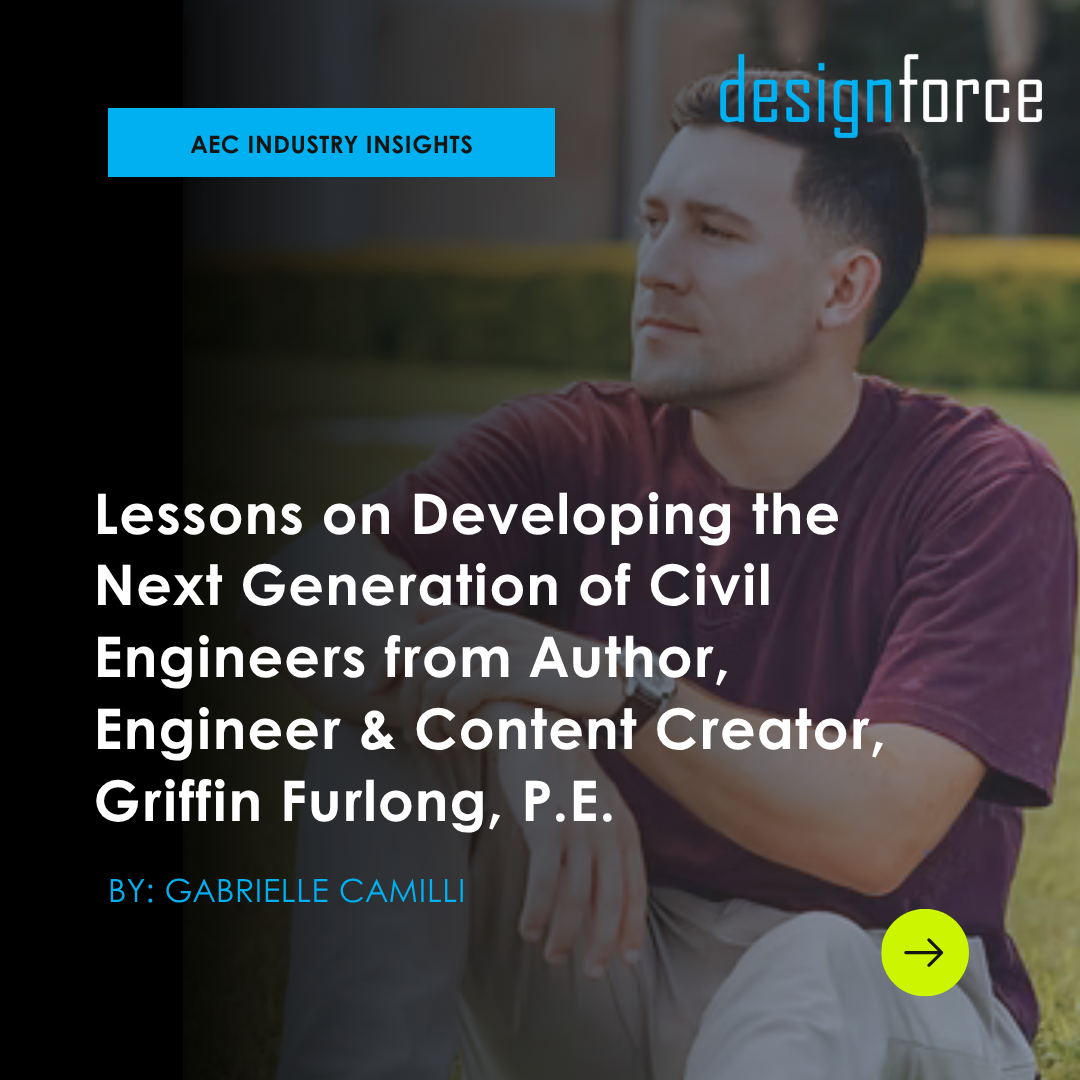
If you’re like me, terminally online and deeply invested in the AEC industry, you’ve probably come across the name Griffin Furlong, PE, aka Civil Griffin.
A licensed professional engineer in Florida, Griffin has built a loyal following on YouTube and TikTok by creating educational content that demystifies land development engineering, career growth, and the realities of working in the profession. Beyond his work as an engineer, he’s also the author of Boundless, where he shares his remarkable journey from experiencing homelessness as a student to becoming a valedictorian and licensed engineer.
We recently sat down with Griffin to discuss why he started creating content, what engineering education gets right and wrong, and what firms can do to better develop the next generation of civil engineers.
______________________________________________________________________________
Q: What inspired you to start creating content?
Griffin: I’ve always been a learner. I love figuring things out, but I also enjoy figuring out the best way to explain something to someone else. There’s nothing worse than not understanding something while everyone around you seems to have already had the lightbulb go off.
When I first started my career, I spent countless evenings and weekends teaching myself programs like WaterCAD, Civil 3D, and StormWise. I was searching YouTube, reading forums, anything I could find. But I realized there wasn’t much content that reflected what we actually do every day in land development. There were plenty of general tutorials, but not much practical guidance. So, I decided to create the resource I wished I’d had. It allowed me to keep learning while hopefully making the path a little easier for someone else.
Q: Have there been any moments where you’ve realized the impact your content is having?
Griffin: It’s hard to point to just one moment because I receive messages all the time, but they’re honestly what keep me going. I’ve had students tell me my videos inspired them to pursue civil engineering. Others have told me they binge-watched my interview preparation videos, landed their first engineering job without prior experience, and credited my videos for helping them succeed.
That’s incredibly rewarding because helping people was the whole reason I started creating content in the first place.
Q: Why should someone choose a career in land development?
Griffin: Because you get to shape the world around you. It’s easy to think you’re just designing stormwater systems or road networks, but then you drive through a completed neighborhood and see families walking with their kids, people riding bikes, and communities thriving.
You realize you helped create that; that’s one of the most rewarding parts of being a land development engineer.
Q: Looking back, what do you wish engineering schools taught more of?
Griffin: I’d love to see more required internships and co-op programs. Students constantly ask me, “How do I even get an internship?” Universities have incredible alumni networks and industry connections, yet finding practical experience often feels like every student is left to figure it out on their own.
Beyond that, I think students need more exposure to what engineers actually do. One of the best experiences I had was learning from an adjunct professor who worked in the industry. We reviewed construction plans, discussed real projects, and completed assignments that mirrored the work we’d eventually be doing. The theory is important, but so is understanding what the profession actually looks like.
Q: What is one non-technical course you recommend every civil engineering student to take?
Griffin: Economics, without question. Understanding how businesses work, supply and demand, and the financial side of projects helps you become a better engineer.
For those interested in land development, I’d also recommend urban planning or local government. Engineers spend a tremendous amount of time coordinating with municipalities, navigating permitting processes, and understanding how development decisions are made. That’s a learning curve many graduates don’t expect.
Q: What advice would you give someone starting their first engineering job?
Griffin: Create your own opportunities. If you want experience, ask for it; volunteer for projects, build templates, start lunch-and-learn programs, run toward the difficult assignments instead of away from them.
When I graduated, I wasn’t handed opportunities; I created them. I worked hard, looked for ways to improve our processes, and consistently asked for more responsibility. Over time, those small actions compounded into career growth.
I’d also say less complaining and more action. I’ve always subscribed to the sentiment that talk is cheap. I feel like if you show up and actually put forth the effort and time, things will pay off. Confidence isn’t something you wait for; it’s something you build by repeatedly doing things that make you uncomfortable.
Q: On the flip side, what can employers do to better support the learning curve for early-career engineers?
Griffin: Your team is ultimately a reflection of your leadership. I think leading by example is one of the best things you can do. Showing people how it’s done is far more effective than simply explaining it. When leaders model the behaviors and mindset they expect from their teams, it creates a culture where learning feels natural instead of forced.
A lot of firms respond to training challenges by putting Band-Aids on the problem. They’ll hire another person before properly developing the people they already have, or they’ll assign self-paced training videos that employees click through without really learning anything.
I’ve seen firsthand how much more effective hands-on training can be. At one company that I worked at, only one person knew how to use a critical stormwater modeling program. Instead of living with that bottleneck, we invested in instructor-led training for the entire team. It cost money upfront, but the return was enormous because suddenly everyone had the skills and the resources to do the work confidently.
I’d also encourage firms to create development plans for every employee. Schedule regular check-ins, listen more, document progress, and give people clear short- and long-term goals instead of hoping they’ll figure everything out on their own.
Lastly, I’d say don’t give up on people too quickly. I’ve seen new hires who struggled early become some of the strongest employees in the office because someone invested the time to help them improve. People often say they’re too busy to develop others, but investing in people is one of the best investments a business can make.
Q: What’s something you wish you knew before entering the civil engineering profession?
Griffin: That the workplace isn’t always rainbows and unicorns. During my internships, I questioned whether I belonged in engineering at all. School had always come naturally to me, but professional work was completely different. There were different personalities, difficult conversations, and plenty of moments where I wasn’t confident.
The biggest lesson was learning not to take everything personally. Business can be direct, and that’s okay. You grow by asking questions, staying curious, and continuing to improve.
Q: Your personal story has inspired many people. How has growing up with adversity shaped the engineer and leader you are today?
Griffin: I would say I live in a constant state of awareness. That’s just how I grew up. And by awareness, I mean being conscious of how I’m feeling emotionally, physically, and financially.
When you grow up in a homeless shelter, eating and sleeping alongside families from different races, religions, and backgrounds, you mature pretty quickly. You become much more observant of the world. You appreciate the small things, and you don’t take opportunities for granted. Every single day I spent in that shelter, I wondered when I was going to get out, and I knew I never wanted to go back. Because of that, I think everything has always been “figureoutable.” I actually saw that word on TikTok, and I love it. I genuinely believe every problem has a solution. Growing up, I hated excuses. I was always asking, “Why? What do you mean? Why can’t we do this?”
That mindset has stayed with me throughout my life. I’m always trying to understand the “why” behind things because I don’t like accepting “no” at face value. I like to challenge assumptions, not to be difficult, but to make sure we’re actually doing the right thing, the best thing, and the most efficient thing. That’s just a product of how I grew up.
___________________________________________________________________________
If there’s one takeaway from our conversation, it’s that engineering is ultimately a people business. The firms that prioritize mentorship, practical learning, and intentional employee development won’t just attract great talent; they’ll help shape the future of the profession.
Related Posts



Let's learn together.
Stay inspired and in the know on all things A|E|C.
Sign up for our monthly newsletter.