

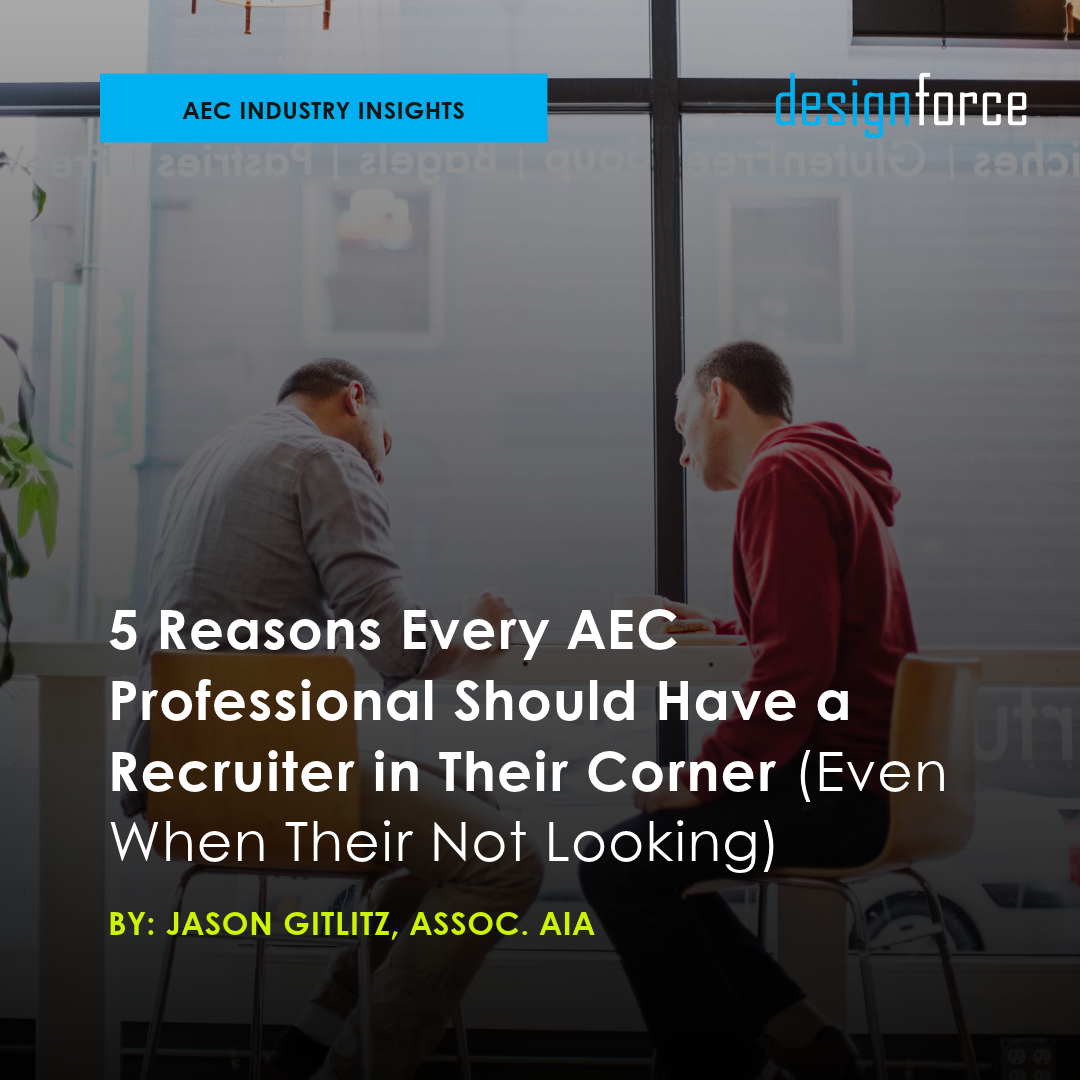
By Jason Gitlitz, Assoc. AIA – Senior Workforce Strategy Consultant, DesignForce
Most people in architecture, engineering, and construction only think about recruiters in two moments: when they’re desperate to leave, or when they’ve just been laid off. The rest of the time, a recruiter’s name sits in an old email thread or a LinkedIn message you never answered. I certainly used to be in this camp.
The truth is, it’s a missed opportunity. I spent about twelve years working for Architecture firms before moving into workforce consulting, and I can tell you the view from both sides is clear: the people who build relationships with the right advisors before they need them make better career decisions, and they make them with less stress.
A quick note on terms. “Recruiter” covers a wide spectrum. While many may be more transactional and commission-driven, some are closer to career advisors who happen to also place people. At DesignForce, we’re the second kind. We’re a strategy and organizational design consultancy serving the AEC industry. While one aspect of what we do is help our clients with strategic (not project-based) hiring, we aren’t commissioned recruiters, and most of our time is spent helping firms figure out how to structure, grow, and (most important) keep their people. That perspective shapes everything below, but most of it holds true for any good recruiter who knows this industry well.
Here are five reasons to have one in your fold.
1. They know what the market is actually doing. It’s very hard to see your own market from inside one firm. You know what you make, maybe what a couple of friends make, and you have a general sense of who’s busy. That’s not much to go on. A recruiter or advisor who works across many firms sees the real picture: what compensation looks like for your role, level, and city right now, which firms are quietly growing and which are freezing hiring, who’s losing people and why, and what titles and responsibilities are being paired together at different practices. That intel isn’t just useful when you’re job hunting. It’s useful when you’re deciding whether to ask for a raise, whether your promotion timeline is normal, or whether the grass really is greener at the firm down the street. Knowing hiring trends by firm also means you can read the room. A firm that has posted the same role three times, or one that’s hiring aggressively in a sector you care about, tells a story that no website will.
2. The good ones can help you when you feel stuck. Here’s something most people don’t expect from a recruiter: help with the not leaving part. Plenty of talented people in AEC firms hit a point where they feel stuck. The path to project manager or associate principal isn’t clear. The promotion criteria are vague. They’re doing great work, but nobody seems to notice, or they’ve outgrown the role, but the org chart has no place for them. These aren’t really job-search problems. They’re organizational problems, and often they can be solved without changing employers. This is where a recruiter with a broader practice earns their keep. At DesignForce, we have an organizational design practice staffed with industrial and organizational psychologists, so we spend a lot of time on exactly these dynamics: how firms structure career paths, why advancement stalls, and what actually moves someone from one level to the next. That means we can help you diagnose whether you’re stuck because of the firm, the role, the manager, or the way you’re positioning yourself. Sometimes the answer is “have this specific conversation with your leadership.” Sometimes it’s “this firm genuinely can’t give you what you want.” Either way, you get an honest outside read from someone who isn’t trying to sell you on a particular outcome.
A recruiter who’s willing to tell you to stay put when that’s the right call is one worth keeping around.
3. When you’re ready to explore, you’re not starting from zero. Most people start building a recruiter relationship at the worst possible time: when they’re already unhappy, already urgent, and already in a hurry. That’s a weak negotiating position, and it leads to rushed decisions. If you’ve already had a few conversations, your advisor knows what you do well, what you care about, what you’re not willing to compromise on, and what would make you move. When you decide it’s time to explore, whether quietly or not so quietly, there’s no long onboarding. You can say “I’m open to hearing about things,” and they already know what “good” looks like for you. This also matters for discretion. AEC is a small world, and everyone knows everyone. Exploring the market is much safer through someone you already trust than through a cold outreach to a stranger. A good advisor can test the waters on your behalf, keep your name out of circulation until you’re ready, and help you avoid the classic mistake of letting word get back to your current firm.
4. The best roles often never get posted. A surprising number of the strongest opportunities in this industry never reach a job board. A firm wins a major project and needs a senior person quickly. A leader is planning for a retirement or an internal shuffle. A practice wants to build a new market sector and wants someone specific, not a stack of applications. When those roles surface in a recruiter’s world, the first question is always “who do I know?” If you’ve built a relationship, you’re on that list. If you haven’t, you’re not, no matter how qualified you are. This is the part I love most about this work. Sometimes a role crosses my desk, and I immediately think of someone I’ve talked to a year earlier, and I can simply tap them on the shoulder. They weren’t looking. They weren’t on the market. But the right thing came along, and because we already had a relationship, they heard about it first. That tap on the shoulder doesn’t happen with strangers.
5. It’s a two-way street that pays off over a whole career. The last reason is the one people underestimate. A good recruiter relationship isn’t a transaction; it’s a long-term exchange, and it gets more valuable the longer it runs. Early on, you get market information and career perspective. Mid-career, you get a sounding board as your decisions get bigger. Later, as you become the person making hiring decisions, you have someone who can help you build your team, benchmark your offers, and spot talent before your competitors do. The same relationship that helped you find your next role will help you fill yours. It’s also worth remembering that you can be a resource back. Recruiters and advisors rely on people who share what they’re seeing in the market, make a smart introduction, or point us toward talented colleagues. The strongest relationships are generous in both directions.
The bottom line: your career in AEC is long, and it’ll have more turning points than you can predict. The firm you love might get acquired. The leader you follow might leave. A market sector you built your reputation in might cool off, and a better opportunity might show up on a day you weren’t expecting it. Having someone in your corner who knows the industry, knows the market, and knows you makes all of those moments easier. You don’t have to be looking to benefit. You just have to be connected. If you’d like to start that conversation, I’m always happy to talk, whether you’re exploring, stuck, curious, or just want to know what the market looks like right now.
Related Posts




Let's learn together.
Stay inspired and in the know on all things A|E|C.
Sign up for our monthly newsletter.